Which House of the Dead Game Is Best
Firm of the Dead
Wed, Nov 15, 2017


-
Platforms:
PC, Arcade, SEGA Saturn
-
Publisher:
SEGA Entertainment
-
Programmer:
Sega AM1 R&D Sectionalisation
-
Genres:
Racing / Track Shooter
-
Release Date:
1998
-
Game Modes:
Singleplayer
House of the Dead
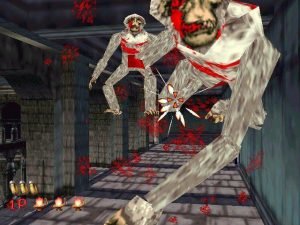 In Sega’s 1996 zombie-filled shooter, The House of the Dead, you play Amanuensis Rogan, an agent sent to investigate a covert regime enquiry lab. As he arrives, he discovers a mansion overrun with the undead. It looks like the lab proprietor, Dr. Curien, has been doing some naughty experiments with cadavers, creating an army of zombies with the probable intention of ruling the world. Grabbing your trusty gat, you head into the business firm, fix to find Curien and dish out the hurt to whatever flesh-munchers who go in the fashion.
Right from the first opening shot, House of the Dead’s pace is nothing short of manic — and that’southward what makes it so much fun. As the computer-controlled camera plods through the house, you apply the cursor to target zombies, mutant monkeys, and other terrors that leap out at yous without warning. While it’s a similar theme to every light-gun game always released, the difference is in how you lot need to shoot your target. If you’ve seen George Romero’s Dawn of the Expressionless, you’re aware that yous can pop a whole clip’s worth of bullets into a zombie’due south breadbasket before it goes down — but if you lot aim for the brain, that sucker drops faster than the value of the ruble. House of the Dead lets you blast off various parts of zombie anatomy, and even gives you the opportunity to blow out their chests — and sometimes they’ll keep coming!
Not everything that moves is hostile; there are scientists hanging near the mansion, running away from their undead captors. These innocent bystanders add an extra gameplay element to the mix — if you manage to save one of the researchers, they’ll thank you and paw over a wellness bundle.
The biggest problem with most rail shooters is longevity and control — after a while, you start learning enemy placement, and the element of surprise vanishes. Just in Business firm of the Expressionless, there are multiple paths through the game, which are triggered by sure events. For instance, at the start of the game, a zombie threatens to throw an innocent off a bridge — if you kill the monster, you’ll head direct into the house, simply if the researcher dies, you’ll head in through the basement. It’s handled in a transparent mode that you probably won’t observe at offset — and I notwithstanding haven’t found all the different paths through the game.
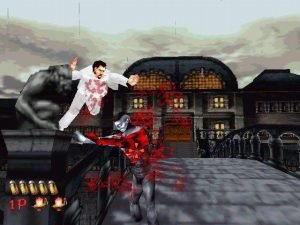 In the arcade, the relentless gameplay resulted in a sweat-drenched player thanks to the aerobic use of the light-gun. But on the PC, nosotros have to brand do with the beggarly mouse — and while information technology doesn’t have the same feeling of the chunky Sega Stunner, it’ll practice in a pinch. Visually, at that place are a few compromises in regards to texture detail and polygon counts, but this looks extremely shut to the arcade. The game supports both hardware and software rendering for all major video carte du jour serial, and Sega has finally listened to its customers and included decent hardware support!
Other PC-specific features include a PC Mode, where yous tin can select different characters with special gun attributes, a Dominate Mode that’s a ‘time attack’ against the large boys, and an choice to change the colour of the blood to a more festive yellow or blue. The activeness is still frantic and exciting, and the inclusion of the mouse as a control device makes aiming feel so much more natural. All that beingness said, this is all the same a 1996 arcade game trapped in a 1998 PC disc.
Arrangement Requirements: 80486DX 33 MHz CPU, viii MB RAM, DOS 5.0
- Purchase Game
N/A
Source: https://oldpcgaming.net/house-of-the-dead/
0 Response to "Which House of the Dead Game Is Best"
Post a Comment